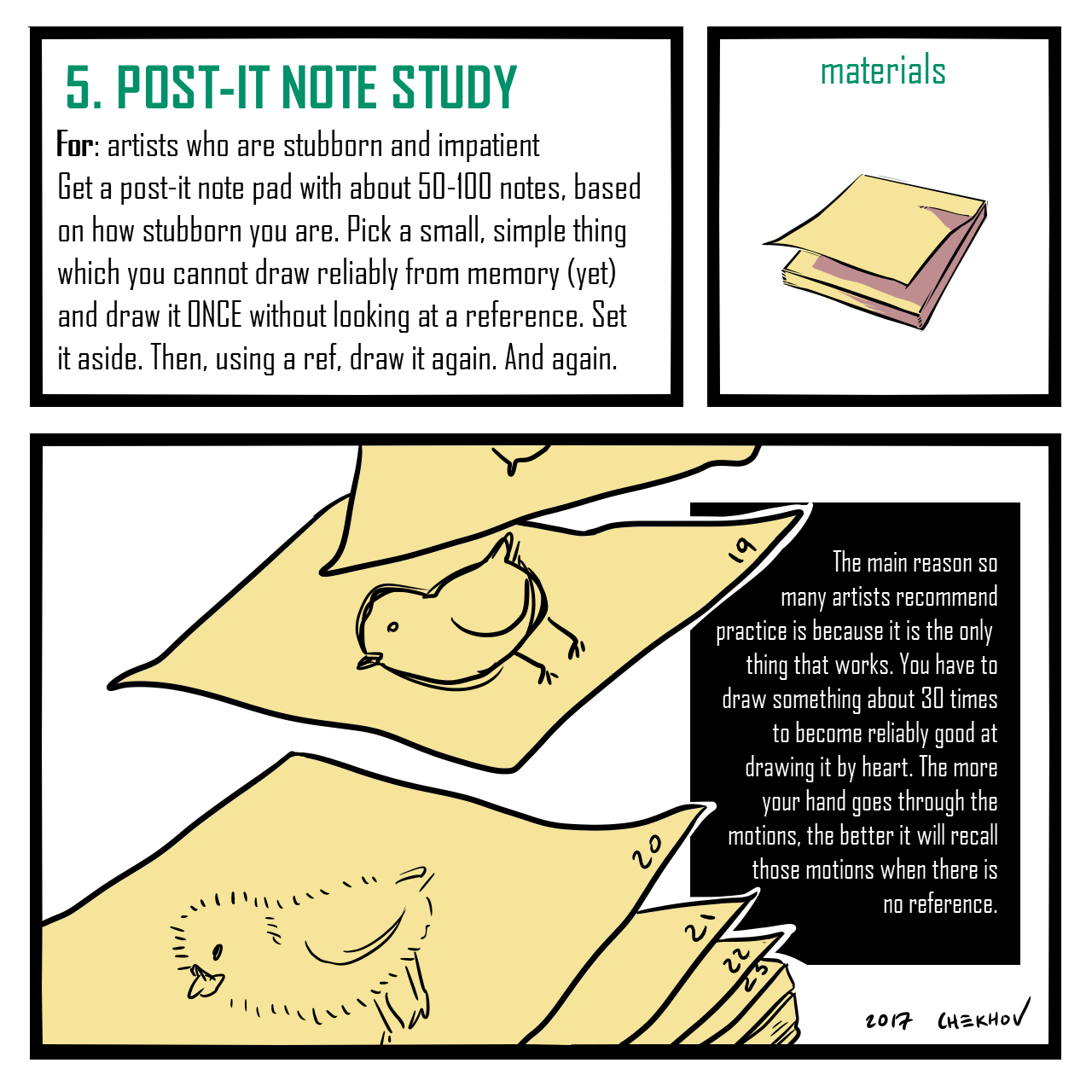
Post it notes are usually found around the office, so this is a great way to use company money to further yourself. I recommend trying to do this quickly, as well. The idea is to un-train your brain from throwing down incorrect details.
The steps are:
Think of one (1) thing you wanna learn to draw.
Draw that thing from memory on a post it.
Look for a picture of that thing on Google, or in a book. Think about what you got wrong in your first drawing.
Take another post-it and draw that thing again. (Without reference.)
Look at a reference again. Check for mistakes again.
Rinse and repeat.
This exercise was inspired by the How to Draw Anything tutorial by Xuu on DeviantArt. I recommend everyone give this a read. It’s an excellent approach to drawing as muscle memory instead of some unobtainable ‘talent’ that you have to magically happen upon.
Coping mechanism is a technique created by oneself to deal with external or internal stress (which could be healthy or unhealthy).
A smal background: I had a bit of psychology during my time in college and this was a subject that got my attention. I wanted to adapt this concept with Taka because Ishida IS a coping mechanism used to deal with Mondo’s death.
Sometimes I wonder if, in his dormitory, we would take Ishida’s mask off to just… cry his eyes out.
The mention of Kiyondo being a mask reminded me, there’s some unused text in the game of a free time event that Makoto could have had with him (There’s a translation of it HERE, although I thought it was on the DR wiki, but couldn’t find it there when I looked for it) and during that it seems like his mask does briefly slip when Makoto brings up Mondo. I really wish that idea could have been built upon, rather than him just being killed off with no resolution.
Part of attempts to ban all research that involves human fetal tissue, because the superstitious feelings of anti-choice fanatics over useless, garbage corpse flesh is apparently more important than any number of entire human lives.
I have had this on my mind for days, someone please help:
Why are dogs dogs?
I mean, how do we see a pug and then a husky and understand that both are dogs? I’m pretty sure I’ve never seen a picture of a breed of dog I hadn’t seen before and wondered what animal it was.
Do you want the Big Answer or the Small Answers cos I have a feeling this is about to get Intense
Oooh okay are YOU gonna answer this, hang on I need to get some snacks and make sure the phone is off.
The short answer is “because they’re statistically unlikely to be anything else.”
The long question is “given the extreme diversity of morphology in dogs, with many subsets of ‘dogs’ bearing no visual resemblance to each other, how am I able to intuit that they belong to the ‘dog’ set just by looking?”
The reason that this is a Good Big Question is because we are broadly used to categorising Things as related based on resemblances. Then everyone realized about genes and evolution and so on, and so now we have Fun Facts like “elephants are ACTUALLY closely related to rock hyraxes!! Even though they look nothing alike!!”
These Fun Facts are appealing because they’re not intuitive. So why is dog-sorting intuitive?
Well, because if you eliminate all the other possibilities, most dogs are dogs.
To process Things – whether animals, words, situations or experiences – our brains categorise the most important things about them, and then compare these to our memory banks. If we’ve experienced the same thing before – whether first-hand or through a story – then we know what’s happening, and we proceed accordingly.
If the New Thing is completely New, then the brain pings up a bunch of question marks, shunts into a different track, counts up all the Similar Traits, and assigns it a provisional category based on its similarity to other Things. We then experience the Thing, exploring it further, and gaining new knowledge. Our brain then categorises the New Thing based on the knowledge and traits. That is how humans experience the universe. We do our best, and we generally do it well.
This is the basis of stereotyping. It underlies some of our worst behaviours (racism), some of our most challenging problems (trauma), helps us survive (stories) and sharing the ability with things that don’t have it leads to some of our most whimsical creations (artificial intelligence.)
In fact, one reason that humans are so wonderfully successful is that we can effectively gain knowledge from experiences without having experienced them personally! You don’t have to eat all the berries to find the poisonous ones. You can just remember stories and descriptions of berries, and compare those to the ones you’ve just discovered. You can benefit from memories that aren’t your own!
On the other hand, if you had a terribly traumatic experience involving, say, an eagle, then your brain will try to protect you in every way possible from a similar experience. If you collect too many traumatic experiences with eagles, then your brain will not enjoy eagle-shaped New Things. In fact, if New Things match up to too many eagle-like categories, such as
* pointy * Specific!! Squawking noise!! * The hot Glare of the Yellow Eye * Patriotism?!? * CLAWS VERY BAD VERY BAD
Then the brain may shunt the train of thought back into trauma, and the person will actually experience the New Thing as trauma. Even if the New Thing was something apparently unrelated, like being generally pointy, or having a hot glare. (This is an overly simplistic explanation of how triggers work, but it’s the one most accessible to people.)
So the answer rests in how we categorise dogs, and what “dog” means to humans. Human brains associate dogs with universal categories, such as
* four legs * Meat Eater * Soft friend * Doggo-ness???? * Walkies * An Snout, * BORK BORK
Anything we have previously experienced and learned as A Dog gets added to the memory bank. Sometimes it brings new categories along with it. So a lifetime’s experience results in excellent dog-intuition.
And anything we experience with, say, a 90% match is officially a Dog.
Brains are super-good at eliminating things, too. So while the concept of physical doggo-ness is pretty nebulous, and has to include greyhounds and Pekingese and mastiffs, we know that even if an animal LOOKS like a bear, if the other categories don’t match up in context (bears are not usually soft friends, they don’t Bork Bork, they don’t have long tails to wag) then it is statistically more likely to be a Doggo. If it occupies a dog-shaped space then it is usually a dog.
So if you see someone dragging a fluffy whatnot along on a string, you will go,
* Mop?? (Unlikely – seems to be self-propelled.) * Alien? (Unlikely – no real alien ever experienced.) * Threat? (Vastly unlikely in context.) * Rabbit? (No. Rabbits hop, and this appears to scurry.) (Brains are very keen on categorising movement patterns. This is why lurching zombies and bad CGI are so uncomfortable to experience, brains just go “INCORRECT!! That is WRONG!” Without consciously knowing why. Anyway, very few animals move like domestic dogs!) * Very fluffy cat? (Maybe – but not quite. Shares many characteristics, though!) * Eldritch horror? (No, it is obviously a soft friend of unknown type) * Robotic toy? (Unlikely – too complex and convincing.) * alert: amusing animal detected!!! This is a good animal!! This is pleasing!! It may be appropriate to laugh at this animal, because we have just realized that it is probably a … * DOG!!!! Soft friend, alive, walks on leash. It had a low doggo-ness quotient! and a confusing Snout, but it is NOT those other Known Things, and it occupies a dog-shaped space! * Hahahaha!!! It is extra funny and appealing, because it made us guess!!!! We love playing that game. * Best doggo. * PING! NEW CATEGORIES ADDED TO “Doggo” set: mopness, floof, confusing Snout.
And that’s why most dogs are dogs. You’re so good at identifying dog-shaped spaces that they can’t be anything else!
this post made my day and has many wholesome quotable phrases.




 Sincorazon15